Thursday, October 17, 2013

Escaping the Car Trap

Many Australians are caught in a vicious cycle where they own or are paying off older cars with intrinsically high running costs, with maintenance, fuel inefficiency, loan repayments, insurance and registration costs all adding up to several thousand dollars per year.


The high cost of participating in this cycle contributes to poverty, and makes it a difficult cycle to escape, for example, by finally purchasing a newer, more reliable and fuel-efficient vehicle. Even then, many of the costs remain, and for Australians on low incomes this represents a significant drain on their limited finances.


Car ownership is practically a background assumption for suburban Australian life. Most of us don't even question the need for a car if you live in the suburbs, and so this cycle continues to hold many Australians in financial bondage. As a long-time cyclist I had long found my own way to step outside of this cycle riding my bike to work, and easily saving enough to buy a good new bike and go on a pleasant holiday each year.


But I am aware that the traditional Australian approach to cycling just doesn't work for many people. The kinds of bikes we ride in Australia are fundamentally pieces of sports equipment, and you need to have a sporty or determined approach, and a willingness to endure a bit of pain, mess, inconvenience and difficulty in the process. If you needed to cart your kids to child care or school, or carry reasonable loads around, e.g., to do the weekly shopping, then the inconvenience rapidly turns to impossibility.


Then through some Danish friends and work trips to Northern Europe I discovered the utility cycling cultures thriving there. Bikes in Berlin, Amsterdam and Copenhagen aren't sports equipment – they are practical, comfortable and convenient transportation appliances.

The differences include many seemingly little things, that together make a profound difference, like a more comfortable up-right riding position and comfy sprung seats, the ubiquitous AXA frame-mounted locks where your key stays in while unlocked, sensible stands that will hold a loaded bike upright (locked and parked in under 10 seconds), proper fenders, chain-cases and skirt-guards that stop you getting dirty when riding, low-maintenance internal hub gears and sealed drum brakes, and thorn-proof tyres with built-in reflectors, through to dynamo lights (with battery backup for the rear, and with the dynamo built into the front hub), low step-through frames that are easy to mount, and copious integrated storage options.

As a result, these statfietsen (city bikes) and bakfietsen (box or cargo bikes) as the Dutch call them are much more practical for life in the suburbs than sports bicycles, in much the same way that a station wagon is more suited to suburban life than is a racing car. Millions of Dutch, Danish and Germans (including many, many Mums) cart children, groceries, building supplies and themselves around comfortably and cleanly using utility bikes.
We tend to view these countries as something of an oddity, and their experience as irrelevant to Australian suburban life. However, the reality is that most of suburban Adelaide is about as flat as Amsterdam, and has considerably less wind, rain, snow, sleet, hail, steep bridges and narrow crowded streets than Amsterdam. In short, Adelaide is arguably better suited to a utility cycling culture than in Northern Europe.
In the year or so that we have owned our cargo bike, I have ridden almost 5,000km, made innumerable shopping trips, carried loads of compost, firewood, bottles for recycling as well as taking the kids to school and childcare and carrying my gear to and from work each day.

One of the less obvious benefits is how the daily kid-run commute is transformed from a stressful necessity into daily quality time with the kids as we sing, play games, avoid traffic snarls, park in the middle of the school yard, and sometimes give little friends a ride when we get there or stop for a few minutes at a playground on the way. Similarly going to the shops is now extremely convenient, parking right outside the supermarket door. But perhaps the most unexpected benefit is avoiding taxi fares when flying for work, as I now load my suitcase into the bike, ride to the airport, park the bike for free for as long as I am gone, and reverse the process on the way home.


It also turns out for us that it is faster to do the morning kid-run by cargo bike than by car – despite the fairly sedate speeds one attains on a cargo bike full of kids and gear, despite the fact that I only average about 15km/hour on the bakfiets. Part of the gain comes from the ability to ride in the school yard instead of having to find a park, and not have to remove, walk at toddler-speed and re-harness Mr. Two when delivering Ms. One to school.

With the advent of electric-assist on bikes, it is possible to average more like 25km/hour on the flat, in your work gear, and without breaking a sweat. This further improves the competitiveness of utility bikes, especially when you consider that peak hour speeds in Adelaide are mostly between 20km/hour and 35km/hour (not counting the nightmare of parking near schools and child-care centres), and that there are often short cuts available for cyclists, and in most cases there are routes that allow you to mostly avoid the main roads and enjoy a pleasant commute that add to your day, instead of ruining it.


In short, while we may not realise it, there is an option for many of us to escape the car trap – or in the least the two-car-family trap – and save money, time and sanity in the process. But first we have to understand the difference between bicycles that are sports equipment and those that are practical transport, and stop thinking about practical utility bikes as a European oddity. As is often the case, it is the cultural change that is the limiting factor.

Carting compost

It's that time of year again when our garden needs compost, and like last year, for smaller loads the bakfiets proved itself a handy solution.  I got a couple of loads of mushroom compost today in under an hour and a half, including all travel time, loading and unloading onto the garden.

An improvement on last year's effort was the judicious use of the gumboots to pack it down firmly in the box, meaning that I was able to get more than 80KG of compost in a single load, up from 60KG last year.

One thing I really like about using the bakfiets instead of a car trailer for this job is that there is no back-straining shovelling and twisting.  You can just park the bakfiets near the garden bed in question, just like a wheel-barrow, and bucket the compost out comfortably until there is sufficiently little that you can just lift out the remainder and tip it on the garden.


Monday, September 23, 2013

Replacing rear-tyre on a cargo bike in pictures

After 4,500km of heavy riding (including up that hill to work every day) the rear tyre of my bakfiets was getting a bit sad.  The tread was getting low:

But more importantly, a loose spoke that I found and tightened a couple of weeks ago or some other cause had caused the wide-wall to partially rupture, resulting in a large bulge that made the bike feel a bit like a clown-bike, bumping up and down every revolution:

The first step was to lift the rear wheel off the ground.  A cargo strap and handy verandah beam made this easy:
Resulting in a convenient air-gap under the wheel:
Next step is to undo the screws on the side of the chain case so that it can be loosened off. The pieces can stay attached, as we only need to be able to move the wheel around and get the chain off of the rear sprocket.
I had oiled the chain a little last week when it started making some noise, but apparently it needs more oil than I gave it. I applied the oil after changing the wheel to reduce mess.  The real reason for taking this picture was to show the bolt and nut to the right of the sproket.  There is one of these on both sides of the hub.  
These need to be undone completely, and the little retaining plate removed on both sides:
Now release the cable from the roller brake. This is quite easy to do, but hard to photograph the process of doing so. First, undo the bolt that holds the brake to the frame. Then pull the bolt where the cable connects to the roller brake to release tension on the cable, then pull the cable to release it from the lug just below the bolt that you have undone.  The brake is now free of the frame, allowing the wheel to be eased out of the frame.
Once that is done, and after jacking the wheel up higher, I was able to ease the axle and hence wheel out of the frame with a bit of fiddling:
Tada, no wheel in the frame.  Note that I left the Nexus 8 gear cable connected, since there was no need to remove it.
Then I removed the tyre and tube.  I was able to do this without even using tyre levers, but you might want to use some:
Then it was time to get the new tube ready, for which I had help unrolling it:


Then it was time to get the new tyre ready.  I am using Schwalbe Marathon Plus tyres which claim to be the ultimate in thorn-proofing.  They are cited as being "quite heavy and awkward to fit".  I don't think they are particularly heavy or awkward to fit -- again, I didn't even need tyre levers to get the new tyre back on.  And compared to the weight of the rear wheel, the tyre is quite, quite insignificant.  And like all Good Sensible Tyres they have a 3M reflective strip for night visibility way better than any wheel reflector provides, and without the weight imbalance that reflectors provide:
Now it is time to reverse the process, and put the wheel back in.  This is the fiddliest bit, as you have to line up those bolts that you first undid.
Again, hard to photograph while you are doing it, but five minutes of fiddling and it was back in:
Here is the bolt nicely lined up and back in place, ready to get the bracket and bolt put back on:
And here they are back on, but yet to be tightened.  Now tighten on each side before doing up the axle bolts, until the chain is reasonably but not too tight, and the wheel is straight.  Then do up the axle bolts.
Finally, put the retaining bolt back on that holds the brake to the frame:
In case you unsure which one it is:
Then put the brake cable and nut back into the spot in the roller brake:
And here is that brake cable lug slotted back in, taken from below. Again, hard to take a picture of on your own with greasy hands:
And, ta-da, all back in.  Then it is time to refasten the chain case:
And after that it was time for a test ride, which happily confirmed that the annoying bumping (and several other odd noises) were a thing of the past, and that the brakes still worked:
The whole process took me about an hour, but if I had to do it again, it would take perhaps half that.

Thursday, September 19, 2013

Back in Amsterdam

Going through my camera I remembered I was in Amsterdam a couple of months ago, and had forgot to post the pictures of my ride there.

First, a shot of a couple of house boats Dutch style.  Basically, with all the canals everywhere a fair few people are lucky enough to own mooring spots, and live in a variety of boats.

Here is one of the canals through Amsterdam, with lots of people enjoying the summer weather:

Here is the ferry across the waterway behind Amsterdam Centraal station, as usual with a lot of bikes on board.  If you want to get your car across, you have to go elsewhere; the ferries are only for pedestrians, cyclists and motorcyclists.

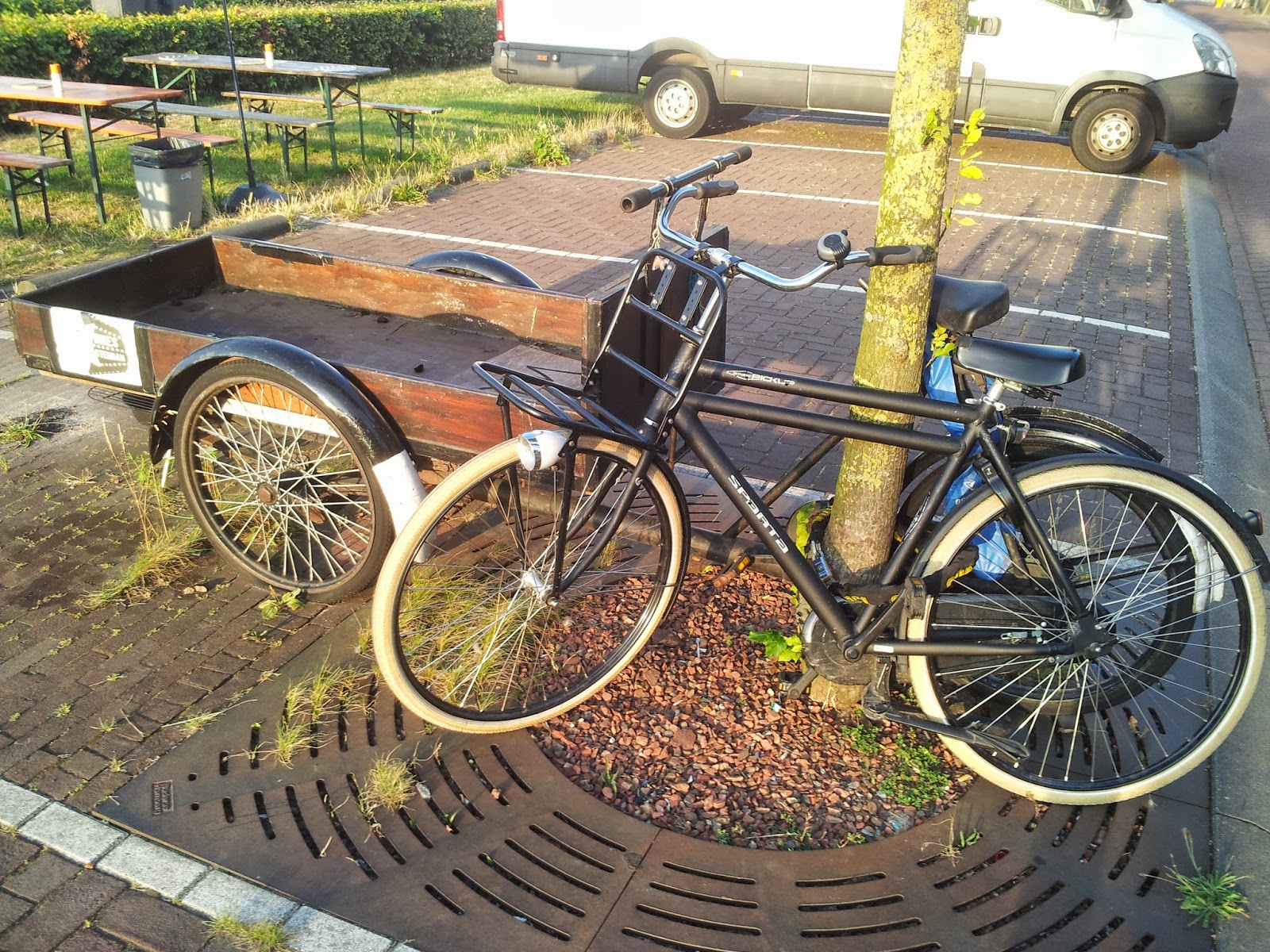
Here is the bike I hired to ride around for the evening.  The double top-tube is a fairly common Dutch design that is good for taller people, as it makes for a very stiff and strong frame.  The integral cargo shelf on the front is also very common. Like most Dutch bikes, the handle bars are swept back and high so that you can sit upright while riding, the chain is in a full chain case, and there are internal gears and brakes for low maintenance, as well as a stand that actually works.

Here it is again next to a big old-style bakfiets with a 4x8 foot tray:

It was also fun to log my ride in Amsterdam on strava to surprise my friends who track my rides back here in Australia.

Actually, it has been quite fun using strava lately.  Partly, it is nice to get an idea of my week-by-week riding, but also because strava is usually used by more serious athletes on much faster bikes.  I have already had to log a support request because strava didn't support bikes over 20kg until I came along. They have now bumped that up to 200kg after I explained just how much stuff I cram in the bakfiets sometimes.  It is also nice to know that I have already climbed more than 2km since I have been logging rides there.  I'll do a proper blog post about it once I have a bit more data on there.


Bakfiets travel, business class style

Last weekend we had a meeting a couple of blocks from home to go to, but Caleb was asleep.  So we made a little nest for him in the box, and transported him in, where he stayed happily snoozing for a while. We then walked the bike around.  Isabel decided to wear my helmet, since I didn't need it to walk the bike:


She also decided that she would like to ride on the back rack Dutch style, which she quite enjoyed.

Avast ye landlubbing blaggards! It be talk like a pirate day

Yesterday was International Talk Like A Pirate Day.

When you have small children and a bike with the turning circle of a barge, this is a recipe for fun.  So 45 minutes with some old canvas, some spare water pipe, tin foil and cardboard, and the HMS Bakfiets was hijacked by a scurvy crew of pirates.

We were fairly well received at Isabel's school, mostly by the young lads.  But the best reception was at lunch time when I rode a colleague down to the University plaza in the box, brandishing our cutlasses and yelling Avast! at anyone in our path.  We even had some piratical conversations with others on the plaza who were aware of the day.  Someone did take a picture of us, but I don't know where it has got to.

Tuesday, September 17, 2013

Article summarising the cargo bike options in Australia (as of 2012)

A little Melbourne-centric, which is after all where most of the cargo bikes are available.

http://rideons.wordpress.com/2012/07/05/ditch-the-car/

It is nice the wide range of bikes that are covered, including a couple of families of bikes that are Australian designed and Chinese manufactured.  Those cargo bikes are not surprisingly much cheaper than the European ones.

I generally agree with their analysis overall, with the exception that they don't consider level of maintenance required, and a comment about ground clearance and an errata on the weight for the Christiania two-wheeler.

The bakfiets, while heavier and more expensive, use the components that they do so that maintenance is minimised as far as possible.  For example, the use of shimano roller drum brakes and dyanamo hubs so that you don't have to worry about brake maintenance or your front light going flat.

The Christiania two wheeler has a very low crank. Even on the bakfiets long I find the crank is quite low if you make a sweeping bend with the wrong pedal down.  Having it even lower, like on the Christiania would annoy me. Also, the article quotes the bike as 23kg when it actually weighs 28kg -- but still a considerable 6kg or so lighter than the bakfiets, and the Christiania fits smaller riders much better.